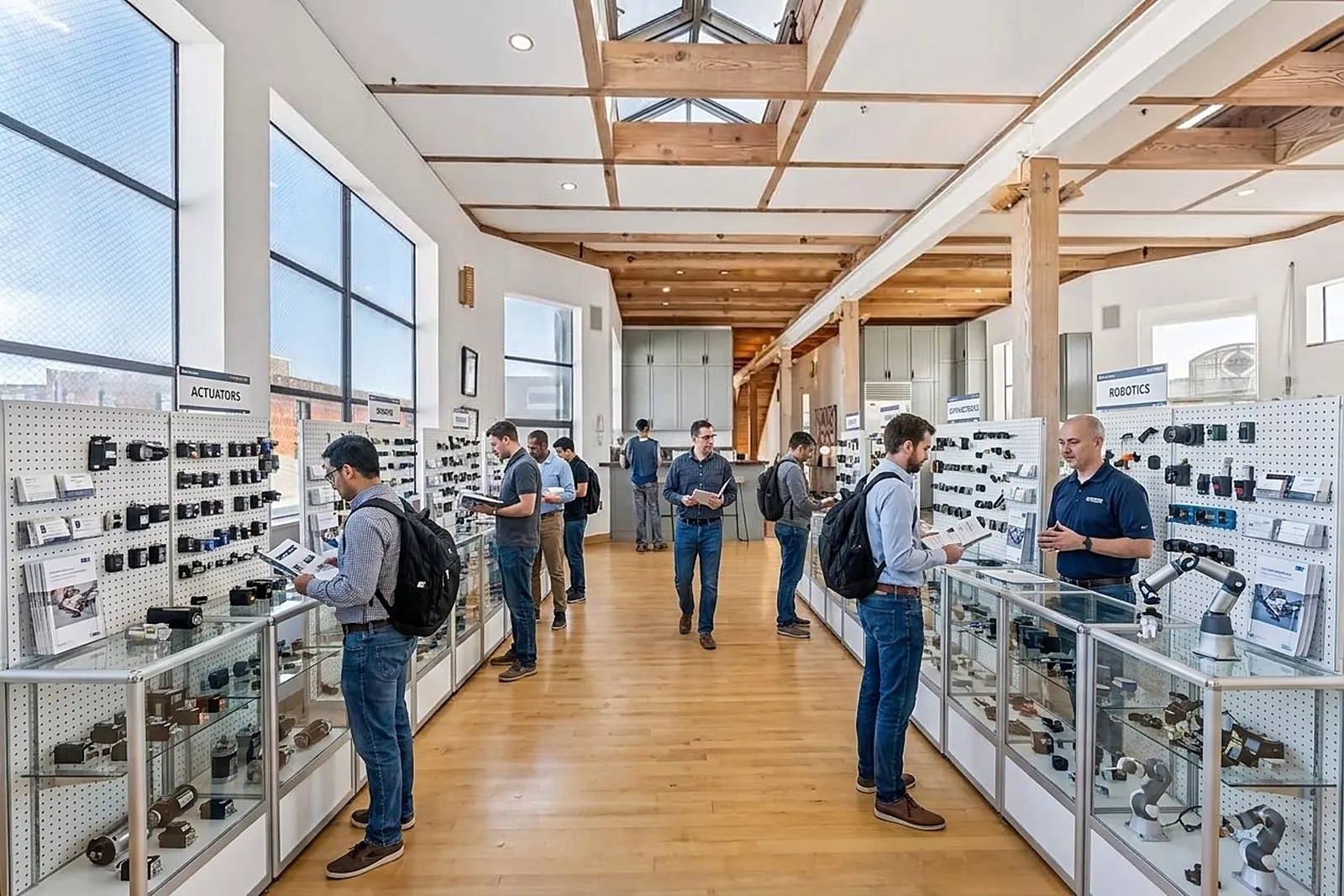
We copied the best sourcing experience in the world and moved it to Bryant Street.
SFbei exists because the fastest way to find a supplier has always been to walk past ten of them holding the part in your hand — and because nobody in North America had built a place where you could still do that.
The problem we kept running into
Everyone who builds hardware in the Bay Area has the same week. You need a part. You search a distributor catalog and get 40,000 results with no photographs worth looking at. You email six suppliers on Alibaba, three answer, two of them are trading companies, one sends a quote for a different part. You put a sample order on a credit card and wait eleven days to discover the connector doesn't seat properly.
Meanwhile the same decision, made in Shenzhen, takes an afternoon. You go to Huaqiangbei, walk four floors of stalls, hold nine versions of the part, talk to people who actually make them, and leave with samples in a bag and three WeChat contacts.
The difference isn't the internet. It's proximity and density — hundreds of suppliers in one building, with physical stock you can touch, and a human standing behind it.
What we built instead
SFbei is that density, rebuilt in San Francisco under Western commercial norms. Suppliers rent a display, not a stall. The catalogs are in English. The contacts are named people with a US phone number. And because nothing is sold on the floor, no one on our staff has any reason to push you toward one shelf over another.
We are not a distributor, a marketplace, or a sourcing agent. We do not take a commission, mark up a part, or sit in the middle of your PO. Suppliers pay a flat annual fee for placement. Builders pay nothing, forever. That is the whole model, and it is deliberately boring — boring business models are the ones that don't corrupt the advice you get on the floor.
Why San Francisco, and why Bryant Street
Because this is where the hardware came back. Robotics companies, AI infrastructure teams, surgical device startups, eVTOL programs, and a generation of founders who grew up doing software and are now discovering that a motor has a lead time. There are more people within a twenty-minute drive of 1070 Bryant who need to source a harmonic drive this quarter than in any comparable radius on earth.
The building itself is a 1918 industrial structure in SoMa — the district that has been making, printing, welding and shipping things for a century. Heavy timber, high ceilings, freight access, skylights, and a roof deck with a view of the skyline. It was built for exactly this kind of use, and then spent forty years not doing it.


Five opinions the whole place is built on.
Physical beats searchable.
A photograph of a connector tells you almost nothing. Holding two of them tells you which one you're specifying. Every serious sourcing decision still ends with somebody touching the part.
Density is the product.
One supplier in a building is a sales office. Two hundred suppliers in a building is a market. The value isn't any single shelf — it's that the shelf next to it is a competitor.
Neutrality has to be structural.
Promising to be unbiased is worthless if you earn a percentage. We don't take one. The only thing a supplier can buy from us is floor space.
Suppliers need presence, not leads.
Overseas manufacturers don't lack enquiries; they lack credibility in the US market. A real address, a real phone number and a shelf someone can visit fixes more than any lead-gen campaign.
The buyer should never pay.
Charge engineers to browse and you filter for the ones with expense accounts, not the ones building something. Free access, forever, is what keeps the floor worth exhibiting on.
A short history
of a long idea.
Dates before today are what happened. Dates after it are what we have committed to. We will keep this page honest as things slip.
- 2024
The tote-bag problem
Our founding team spent a decade sourcing industrial components between Shenzhen, Hong Kong and the Bay Area — and kept noticing that the useful part of every trip was the four hours spent walking a market, not the four days spent in meetings.
- 2025
Counting the walk-ins
We ran the numbers on Bay Area hardware: how many robotics, AI-infrastructure, medical-device and mobility teams sit within a 20-minute drive of SoMa, and how often each of them opens a new sourcing search. The density was the answer.
- Mar 2026
1070 Bryant
We took the building — three floors, roughly 7,000 square feet, heavy timber, skylights, freight access and a roof deck, a block from the 101 on-ramp.
- Jul 2026
Design and fit-out begins
Floor plans, case work, the sample-library drawer system, the wayfinding scheme, and the first conversations with anchor suppliers in Shenzhen, Taipei, Stuttgart and Osaka.
- Q4 2026
Founding supplier cohort
Applications open for the first cohort. Founding exhibitors get first choice of floor position and a fixed rate for their first three years.
- Q1 2027
Builder pre-registration
Screening opens for engineers, founders and purchasing teams. Doors open to registered builders ahead of the public launch.
- Spring 2027
Opening
Three floors live, the directory published, and the events calendar running monthly. See what's planned.
1070 Bryant Street, in brief.
1070 Bryant Street
SoMa, San Francisco, CA 94103. Between 9th and 10th, a block from the 101.
Built 1918
A heavy-timber industrial building — the MCMXVIII on the parapet is original.
7,000 sq ft
Three floors plus a roof deck, freight access and a lower-level receiving bay.
Open year-round
Not three days in a convention hall. Every week, all year.

The floor is being built.
The list is open.
Suppliers can apply for the founding cohort now. Builders can pre-register for free access from day one.