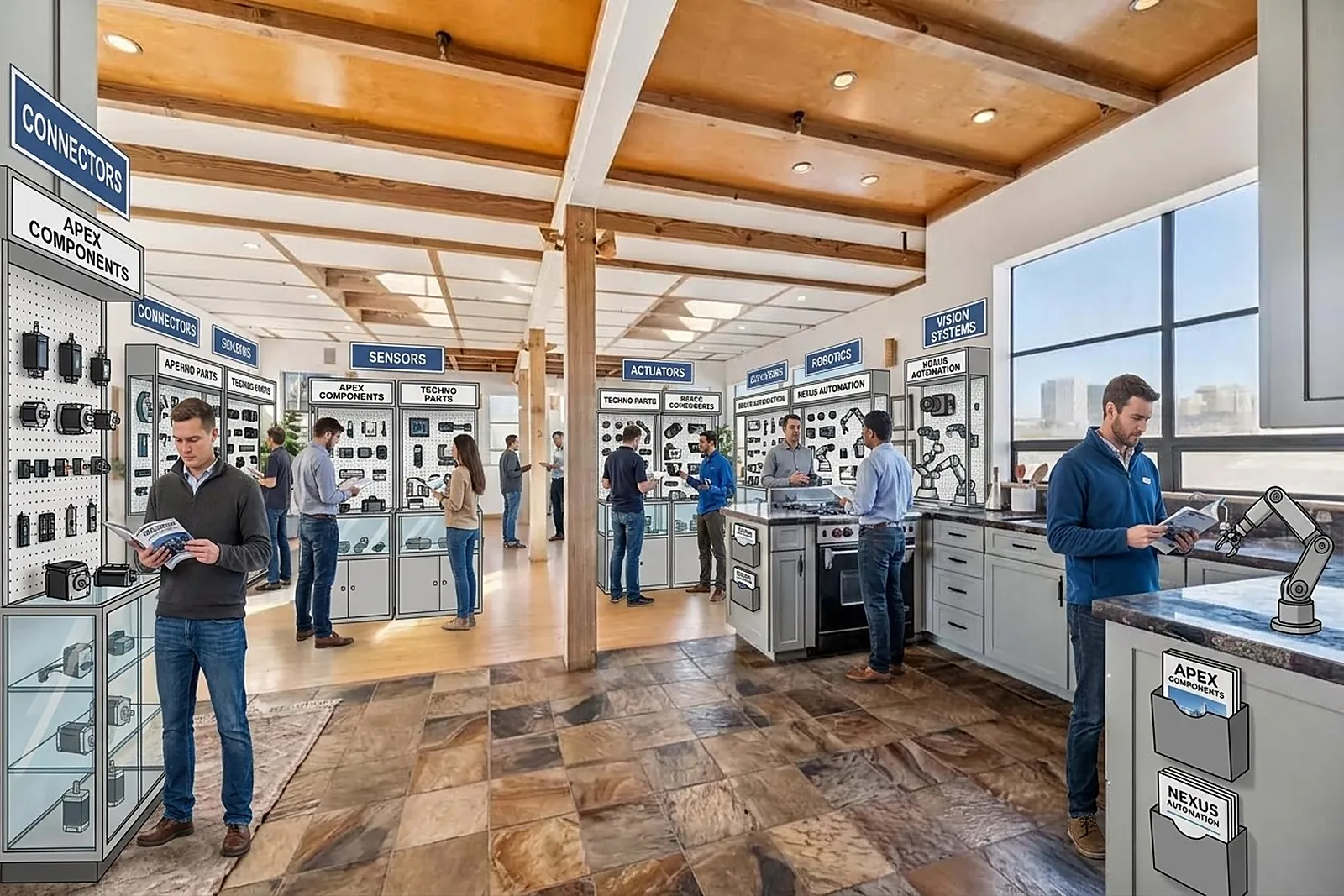
Huaqiangbei, and why we borrowed its second half.
Shenzhen's Huaqiangbei is the densest electronics market on earth and the fastest place in the world to source a component. This is what it does right — and which parts of it we could actually move to San Francisco.
What Huaqiangbei actually is
Huaqiangbei (华强北) is a commercial district in the Futian area of Shenzhen, about a kilometre long, built around a street that was originally an industrial zone for electronics assembly. Over roughly three decades it turned into the largest electronics marketplace in the world.
The core of it is a cluster of multi-storey malls — SEG Plaza and the Huaqiang Electronics World buildings are the famous ones — where each floor is divided into hundreds of small booths. A booth might be two metres wide. One sells nothing but tactile switches. The next sells nothing but ribbon cable. Upstairs is a floor of LED modules, then a floor of phone parts, then a floor of test equipment. Individually each stall is tiny. Collectively the building holds a component inventory that no distributor on earth can match for breadth.
The result is a sourcing experience that has no real equivalent anywhere else: you can walk in with a broken part in your pocket and walk out three hours later with nine alternatives, four quotes, two samples and the WeChat contact of someone whose factory actually makes it.
Why it works — and it isn't the prices
People assume Huaqiangbei's advantage is cost. It isn't, really. The advantage is time-to-answer. Four things produce it:
- Density. Hundreds of suppliers within a few minutes' walk, so comparison is free. When the alternative is one aisle away, nobody can quietly overcharge you or oversell a spec.
- Physical stock. Everything is on the counter. You are not reading a datasheet and hoping — you are holding two parts and feeling the difference.
- Direct access to people who know. The person at the booth usually has a real relationship with the factory, often is the factory. Technical questions get technical answers in minutes, not a ticket queue.
- Serendipity. The part you didn't know existed is on the way to the part you came for. Nobody has ever had that experience inside a search box.
What doesn't travel
We are not pretending to recreate Huaqiangbei. Several of its defining features can't and shouldn't be exported:
- It's a selling market — cash, counters, and stock that leaves in a carrier bag. SFbei deliberately doesn't sell anything.
- Its supply chain is grey in places. Provenance, authenticity and counterfeit risk are real problems in a market that size, and they are exactly the problems a Western procurement team can't accept.
- It runs on relationships, negotiation norms and a language most Bay Area engineers don't speak.
- It exists because Shenzhen's manufacturing base is on its doorstep. San Francisco's isn't.
What we took
The four things in the list above — density, physical stock, direct human access and serendipity — are the actual product. None of them require a grey market, a cash counter or a flight. They require a building, a floor plan, and enough suppliers to make comparison free.
So SFbei is Huaqiangbei's discovery layer, rebuilt under Western commercial norms: named companies, documented provenance, English catalogs, US contacts, real invoices — and no transaction on the premises at all. The bei in our name is the 北 in 华强北: it means north. We are the northern one, about six thousand miles north-east across the Pacific.
The same idea under different rules.
| Huaqiangbei, Shenzhen | SFbei, San Francisco | |
|---|---|---|
| Scale | A district of malls; thousands of booths across several buildings | One building, three floors, ~7,000 sq ft |
| Model | Sell on the spot — cash, counters, stock in bags | Showcase only. Nothing is sold or bought on site |
| Who exhibits | Traders, agents and factories, often indistinguishable | Named manufacturers, vetted and documented |
| Who visits | Anyone, from repair shops to global buyers | Screened builders: engineers, founders, buyers |
| Cost to browse | Free | Free, forever, after a one-time screening |
| How it earns | Margin on goods sold | Flat annual placement fee. No commission, ever |
| Provenance | Variable — counterfeit risk is a real concern | Documented: company, factory, certifications |
| Language | Mandarin and Cantonese, mostly | English, with supplier contacts in their own language |
| Transaction | On the counter | Directly between buyer and supplier, off-site |
Huaqiangbei figures are widely reported approximations, not audited numbers — the district is large enough that nobody has an exact count.
Four market habits, rebuilt as building design.
Density → category aisles
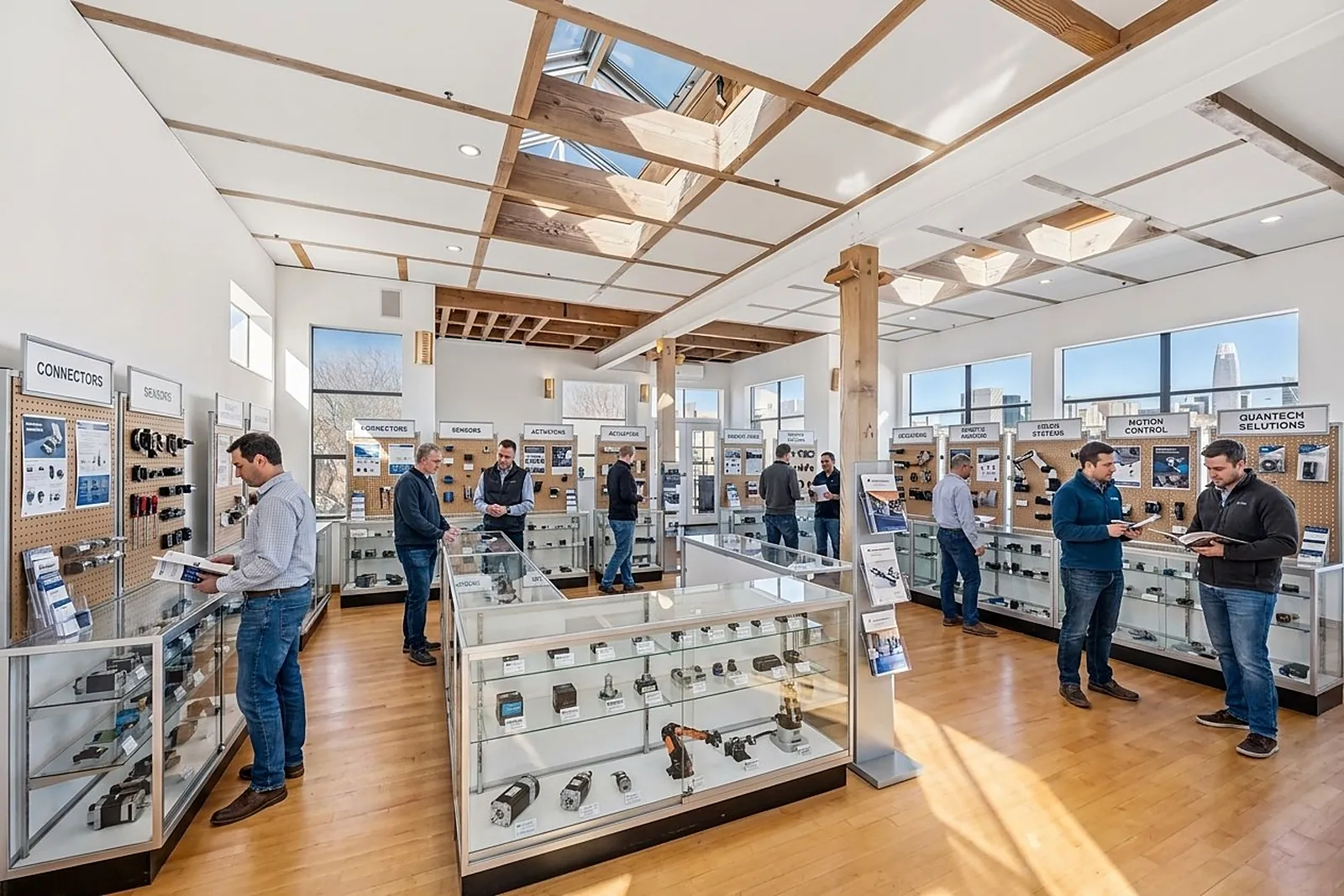
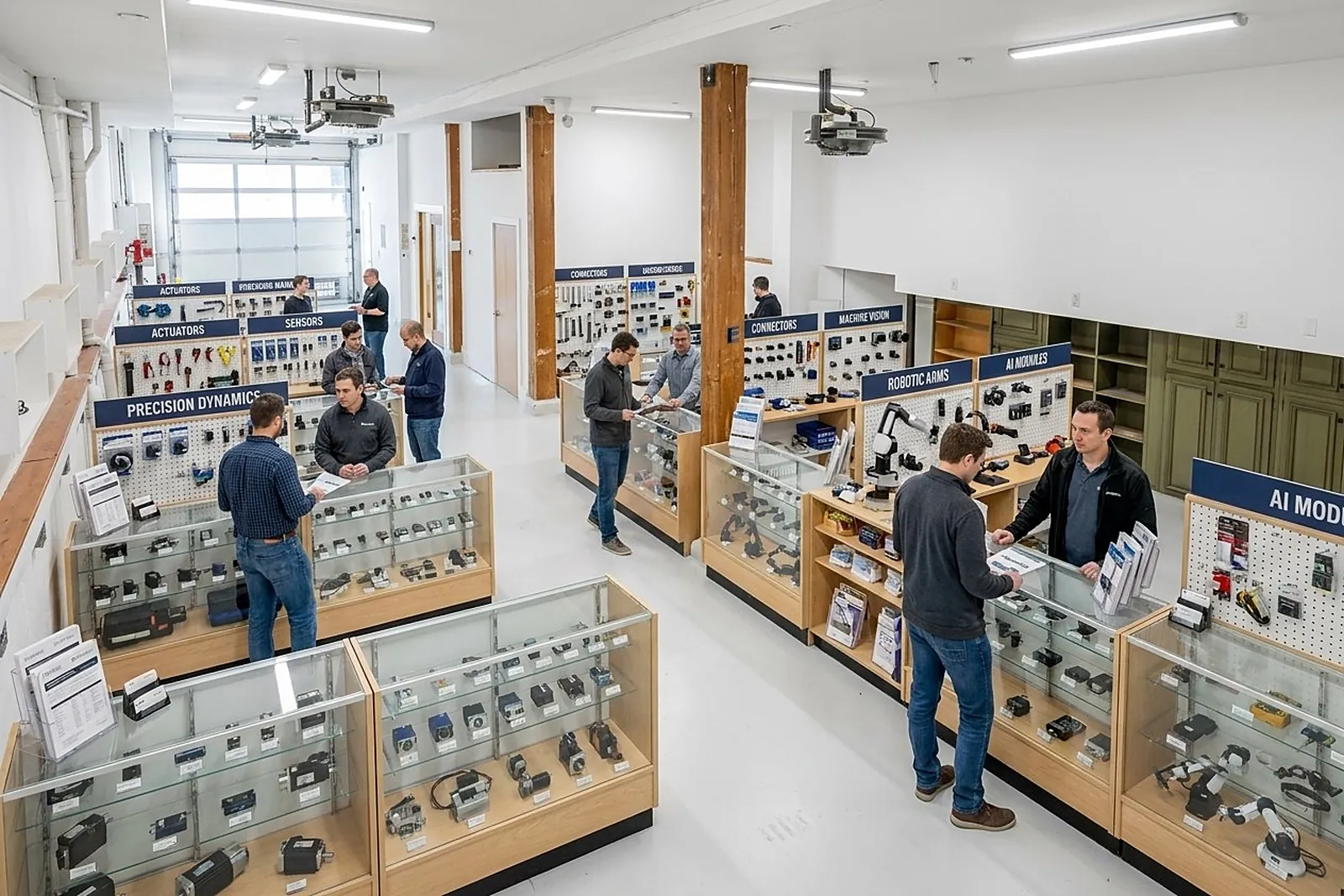
We arrange the floor by category, not by supplier. Your connector options sit together in one aisle regardless of who makes them — so comparison stays free, exactly like walking a row of booths.
Physical stock → the sample library
A wall of labelled drawers on the components floor holding loose parts you can pull, measure and photograph. It is the counter, minus the cash register.
Direct access → named contacts
Every display carries a named sales and a named engineering contact, their time zone and the languages they work in. Our staff make the introduction rather than gatekeeping it.
Serendipity → a route, not a search box
The building is laid out so you walk past adjacent categories on the way to the one you came for. The most useful thing you find is usually the thing you weren't looking for.
Density you can walk through.

Is this just Huaqiangbei with a US postcode?
So is SFbei importing grey-market parts?
Why not just fly to Shenzhen?
Are the suppliers all Chinese?
Do you help with import, duties and logistics?
What does “bei” mean?

Six thousand miles north-east.
Same idea.
If you make components, this is the shopfront you have been missing in the US. If you build hardware, this is the afternoon you have been missing.