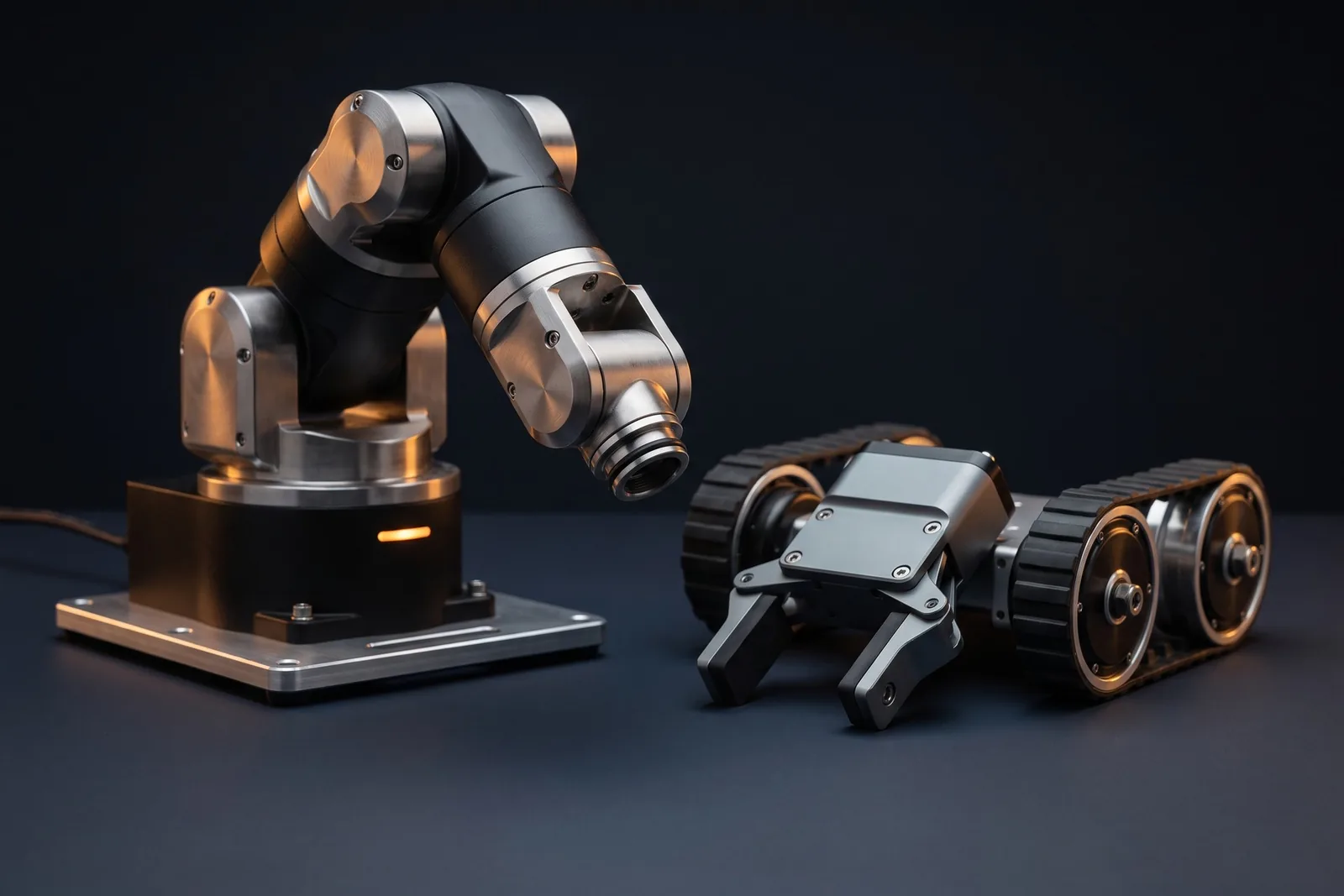
Robots & robotic systems
Whole machines, and the parts of a machine that decide whether it ever leaves the lab. Robotics is the reason most of our buyers walk in, and it is the category where a datasheet helps least: reach, backlash, grip force and cycle life are things engineers want to stand next to.
15 shelves
we want filled.
Every line below is a display we would like somebody to own. Several are still completely open.
- 01
Six-axis industrial arms
Payloads from 3 kg bench units to 500 kg foundry arms, with repeatability figures and duty-cycle curves behind them. Reach envelope, wrist torque, IP rating and the controller it ships with matter more to an integrator than the number on the quote.
- 02
Collaborative arms
Force-limited arms rated to ISO/TS 15066, with the power-and-force limiting test data to prove it. We are interested in cobots that hold accuracy at speed, not only ones that are safe when crawling.
- 03
SCARA and delta robots
High-rate pick-and-place: four-axis SCARAs for assembly and insertion, delta arms for packaging lines running above 150 picks a minute. Cycle-time proof on a real part beats any spec sheet.
- 04
Cartesian and gantry systems
Multi-axis gantries and cantilever units built from linear modules, for large work envelopes where an articulated arm cannot reach. Rigidity, straightness over travel and the cable management are what get inspected here.
- 05
Autonomous mobile robots
AMR platforms with onboard SLAM, safety-rated scanners and a documented fleet interface. Buyers want to see the localisation hold up in a busy room, which is exactly what a showroom floor is.
- 06
AGVs, tuggers and lifts
Line-following and magnetic-tape vehicles, tugger trains, scissor-lift and forklift AGVs. Lower glamour than AMRs and often the right answer, especially for retrofits into an existing plant.
- 07
Humanoid and legged platforms
Bipeds, quadrupeds and the joint modules they are assembled from. San Francisco has more humanoid programmes per square mile than anywhere on earth, and almost all of them are still sourcing actuators.
- 08
Grippers and end effectors
Two-finger and three-finger parallel grippers, angular and adaptive designs, soft and food-safe variants. Bring stroke, grip force and cycle-life data; buyers will bring their own part to test on.
- 09
Vacuum, Gripsters and handling
Suction cups, gripsters, bellows, area grippers and electropermanent magnets. The most specified end-of-arm technology in the world, and the one most often chosen on the wrong criteria.
- 10
Tool changers and couplers
Robotic quick-change couplers passing air, power, signal and fieldbus in one pull. Repeatability after ten thousand changes is the specification that matters, and few catalogues publish it.
- 11
Robot controllers and pendants
Standalone motion controllers, teach pendants and the ROS 2 or EtherCAT bridges that let an arm join a cell built by somebody else. Open interfaces are a selling point here, not a risk.
- 12
Collision protection and compliance
Crash sensors, overload clutches, remote-centre compliance devices and active force-control wrists for insertion, deburring and polishing tasks that no rigid arm will ever do well.
- 13
Cells, fencing and safety
Guarding, light-curtain-integrated fencing, interlocked doors and prebuilt cell frames. Boring to look at, on the critical path of every deployment, and usually specified two weeks too late.
- 14
Palletising and packaging cells
Palletisers, depalletisers, case erectors, layer grippers and pallet conveyors. High-volume, high-repeat business for the supplier who can show a proven pattern library and a fast changeover.
- 15
Drones and field robots
Airframes, marine and subsea platforms, agricultural and inspection robots, plus the propulsion and airframe parts they are built from. Mass budget is the whole argument in this aisle.
How to stand out
in this category.
Strongest applications ship a working cell we can run on the floor, publish repeatability and duty-cycle data rather than peak numbers alone, and can name the controller, the fieldbus and the safety rating a US integrator will be asked about.
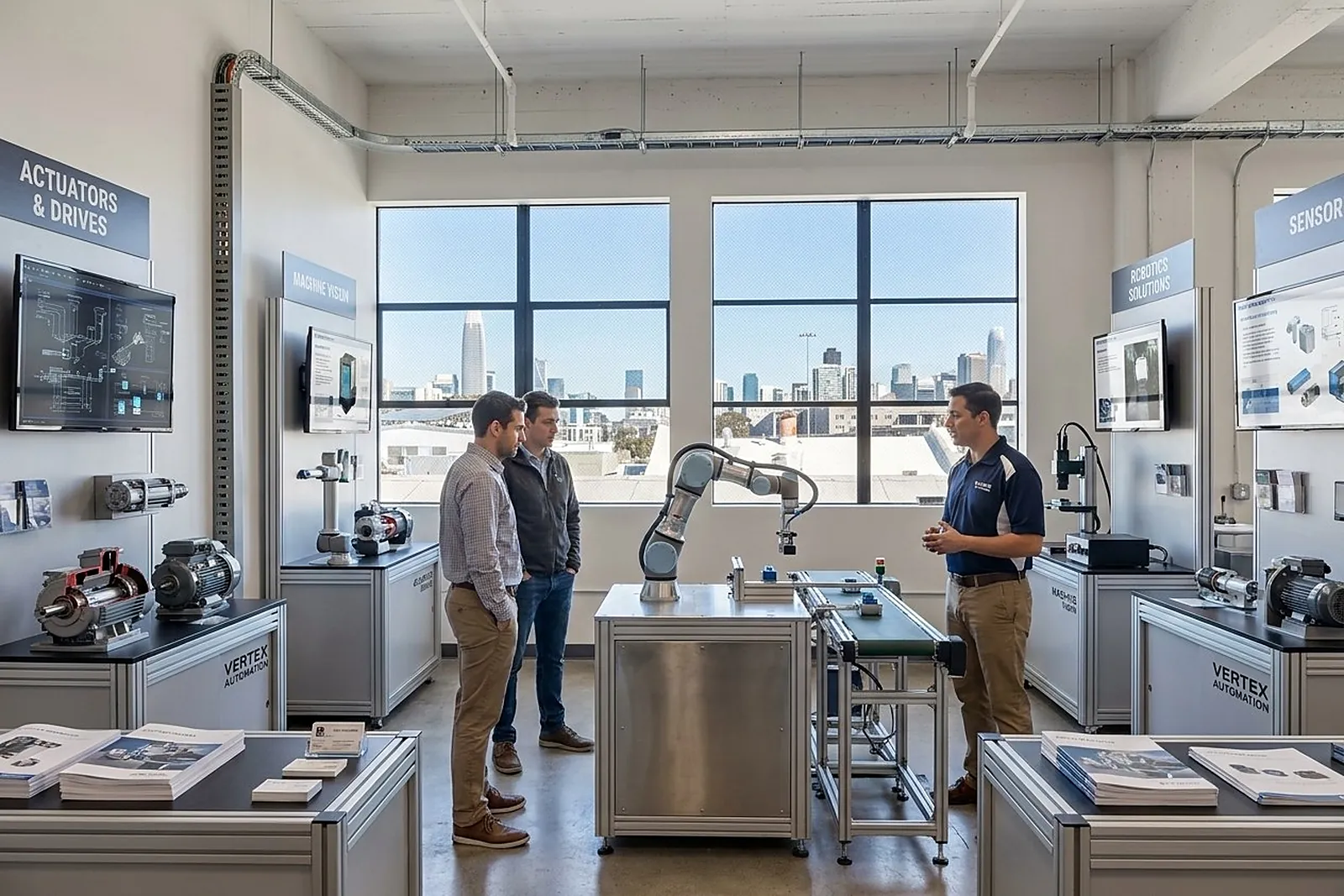
Neighbouring
categories.
Most suppliers fit more than one. Apply against the closest and tell us the rest in your company bio.
Own this shelf.
All year, in San Francisco.
A staffed display on the relevant floor, a US address and phone number, and a listing buyers search. Flat annual fee, no commission.